The Pool

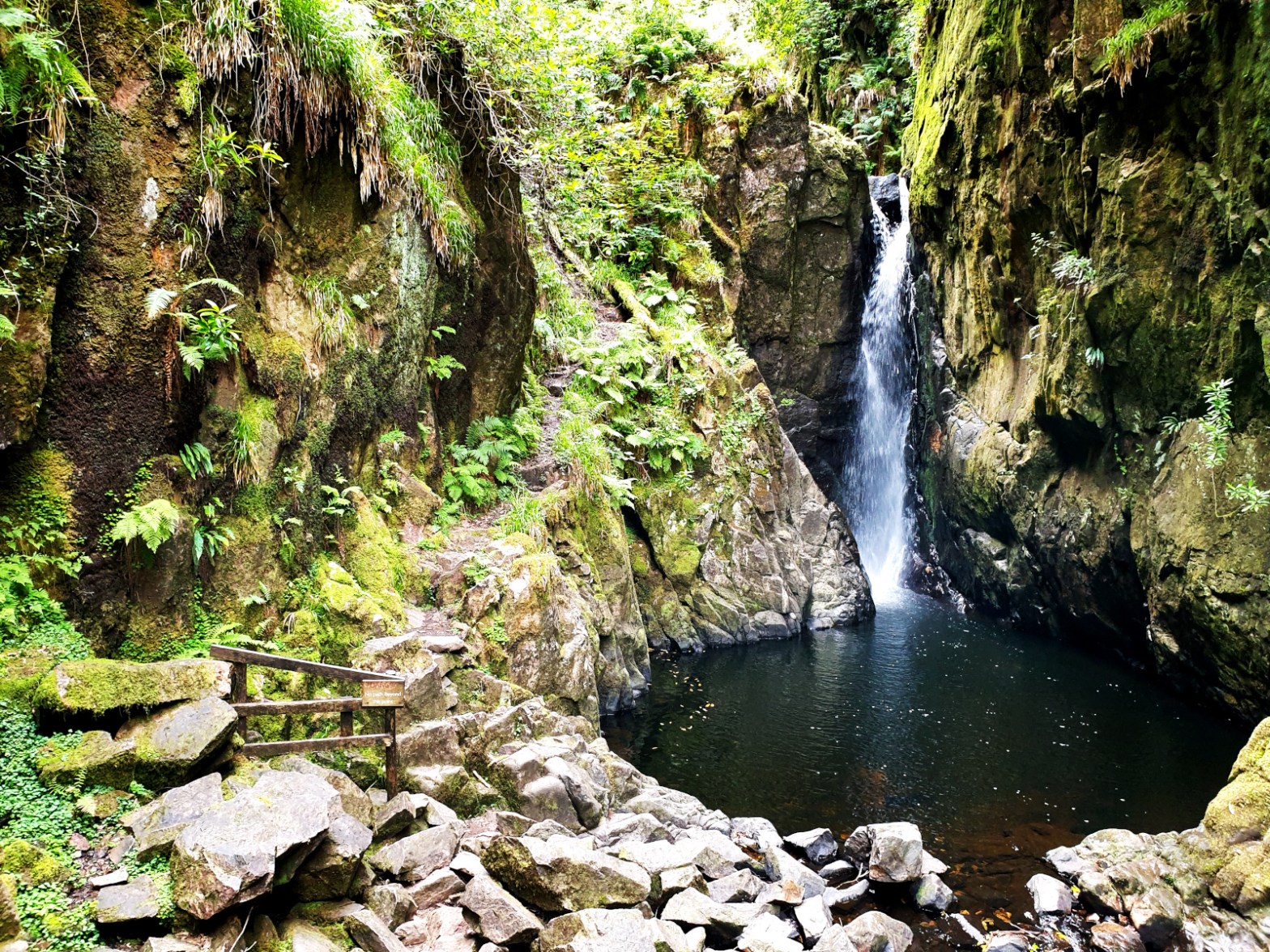
One of my favourite things is tromping around in the wilderness. The place in this photo is part of the reason why. At the end of a narrow and winding path a short walk off the main road through Eskdale you will find this little grotto. Well, once upon a time. Since the first time we visited the area the path leading to the falls has been closed. Given the scramble at the end to reach the pool I’ve never tried pushing my luck to see if we could actually make it through. I choose life.

I will make it back one day. It’s a beautiful spot and my picture doesn’t do it justice. To compensate for not being able to get there, I’ll make up some fanciful nonsense instead. If the path was open, I’d probably write something else. No amount of made up magic can stand up to the peaceful seclusion of the real thing. Still: beggars and choosers.


I nearly stumbled, climbing on to the rock that would allow me to see over the scree slope before me. Fool that I am, I glanced down, back the way I’d come. Falling from here would be painful at best. At worst, let’s just say I wouldn’t be in a position to complain about it.

In my life, risk is something I’ve always avoided if at all possible. Finding myself in this precarious position would have seemed highly unlikely just a few short weeks ago. It’s amazing how fast things can change.

As I straightened up fatigue nearly finished the job that my stumble had failed. It had been a long hike to get this far. Despite the lightness of my depleted pack its mass cut into my weary shoulders. I was glad of that, in a way. I’m not much of a forager. The last time I ate wild food I was sick for a week. By my reckoning there was easily enough food in my bag to get me home. By the feel of its weight on my shoulders it must have held a year’s supply of meals.

At last I turned my gaze past the latest obstacle and saw my goal. A stream of water tumbled brightly down a cliff splashing into the pool below forming iridescent ripples that sparkled in the sunlight. The impact raised a fine mist that cast a rainbow over the water like a magic gateway into another world. But it was not another world that drew me here. No, it was the consequences of living in this one that held my interest.

I scrambled down the far side of the rock-heap, barking both shins several times before I made it to the pool’s edge. From there I could feel its power. Even I, the person least sensitive to magic that I’d ever known. An electric tension in the air that promised change. It was then that my nerves deserted me, though only for a moment. The silent stillness seemed somehow sacred. Within the ring of cliffs even birdsong had fallen silent, although the forest had resounded with it at the top of the rocks where I’d climbed down. Disturbing anything seemed sacrilege.

My hand trembled a finger’s span above the pool’s surface. In that moment I almost left without my prize. But there was no turning back. It wasn’t a matter of ‘after what I’ve been through’. Had this all been merely for my own benefit I would have abandoned my path days ago. Legend held that these waters could cure any ill and I needed that now. Oh how desperately did I need that. If the legends were true.

If! Though doubt had been my companion every step of the way, she had deserted me now. In that place there was no question. I dipped my hand then placed a single drop of water on my tongue. The tight electric sensation flooded through me drowning every other sense.

When I could see again the scrapes and cuts and bruises on my legs were gone. Not healed. Not exactly. Rather as if they had never been there at all.

My fingers shook as I fumbled my bag open. I pulled out a set of small glass bottles and unwrapped their felt coverings. One after another I filled them from the pool. I hesitated after the fourth. Not knowing the power here I’d brought eight bottles – all I could muster before I set out. I saw now that filling them all would be a vile disrespect. That would be healing enough for two lifetimes of everyone I knew. What could I do with all that? Profit, one way or the other. Either in money or influence. It was a necessary consequence of holding such power. No. Even if I tried to do only good with it: give it all away to the neediest cases. Who was I to decide such things as who else should benefit? I would take no more than I needed and not deplete this magical place with my greed.

I stoppered my bottles and carefully stored them in my bag. Without another look I turned my back on that most enchanted place and returned to the people I loved.
The Troll

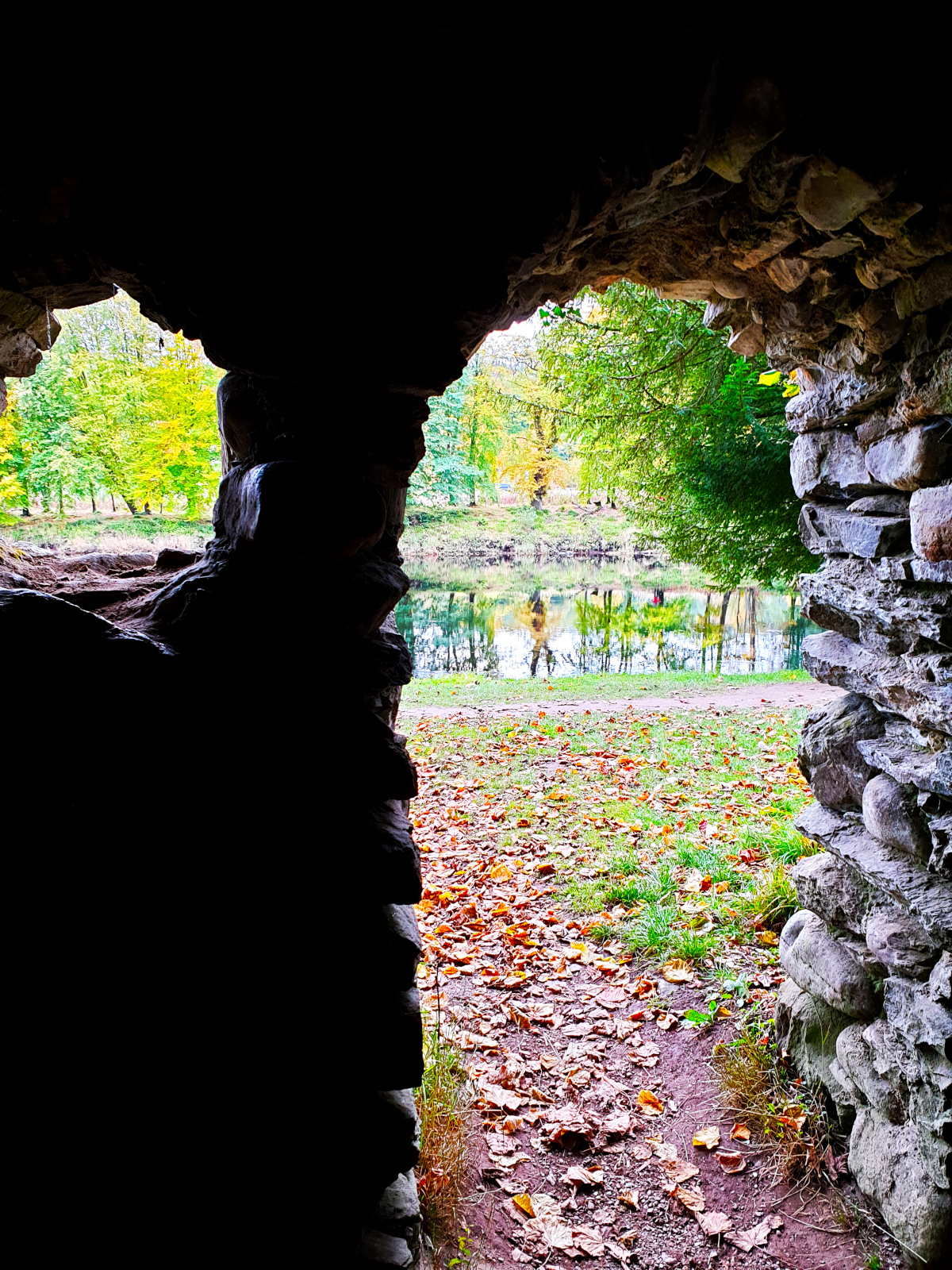
I have to introduce this week’s story prompt photo with more than my usual amount of vagueness. I took the photo on a family outing to… somewhere. I’m moderately confident that it’s somewhere in the north of England. I recall the holiday to a wee place just off the A1, and I think this was taken from within a little hermitage on the grounds of a castle we visited. I’m a even more hazy about the geography. Typically I leave navigation up to my better half, simply taking the turnings as directed. The upshot is that I have a foggy notion of where most locations in my life are. I’d make an effort to do better but I hold with the wisdom of picking one’s battles carefully. I think this is not the hill I’ll choose to die on. Of course, what would I know?


The bright morning light burned into my home, searing bright against the soothing darkness inside. My eyes blinked rapidly until they adjusted. In some ways it was an unforgiving home. But it was mine. I’d built it with my own two hands. The sweat and blood in the mortar was mine alone. Not much of a house, some might say. No door, nor glass in the windows. Nothing for a floor but hard-packed earth. As if there could be anything better than keeping that connection with the world itself. Let them say what they want. The fools.

I’ll grant you, a house like this, stone-lined and dug into the side of a hill was unusual for people like me. Most trolls live in mountain caves. There’s a few eccentrics who live under bridges. There’s a big iron bridge to a ways off to the south that I hear houses a whole community of trolls, if you can believe it.

Well, I like my house. It’s cool in the summer and cosy through the winter. Most of all it lets me see the world in peace and quiet. From here I can see the birds as they flit around on their business. The wag-tails are my favourites. Little black and white chaps that beat their tails up and down like they’re conducting an orchestra that only they can hear. In the evenings a family of foxes dart back and forth on some errands that I can only guess at. I have hedgehogs to tend my vegetable patch and even fish in the river.

But trolls don’t like ‘nice’ things like all that, surely? Well, perhaps not all of us, I suppose. It’s silly to think that an entire species thinks and acts and likes in just one way. Sure, I know what your stories are. The wicked, ugly trolls that lie in wait for unsuspecting travellers . Admittedly, there’s a few of us like that. That’s true of all folks, isn’t it?

As for me. What do I like? Well that’s the reason for my unusual house. And indeed the reason for the visitor I see now across the river. Just a speck of red reflected in the water. I know what to look for, though. I’m used to it now. It’s all about my treasure.

No, not that type. What use would a troll have for gold and jewels? My treasure is more glorious and more fragile. It’s the reason I dug into the hill. Why I lined it so well with stone and mortar. For a steady temperature. So that the air isn’t too moist and so that the sunlight doesn’t fade anything. I’ve spent years gathering it, cataloguing it, shelving it.

My treasure is books!

I must go and help my visitor cross. The greatest thing about my treasure is that it is worth so much more when shared. If I’m an especially lucky troll she might have brought something to add to it.

Tree-Forge

The origins of this week’s story prompt photo are a little muddy in my memory. I know I took it on a family walk during lockdown 1. Okay, that’s not true — at this point the lockdowns blur together somewhat, but I think it was the first one. I’m mostly sure that it was in Blairadam forest just off the M90.

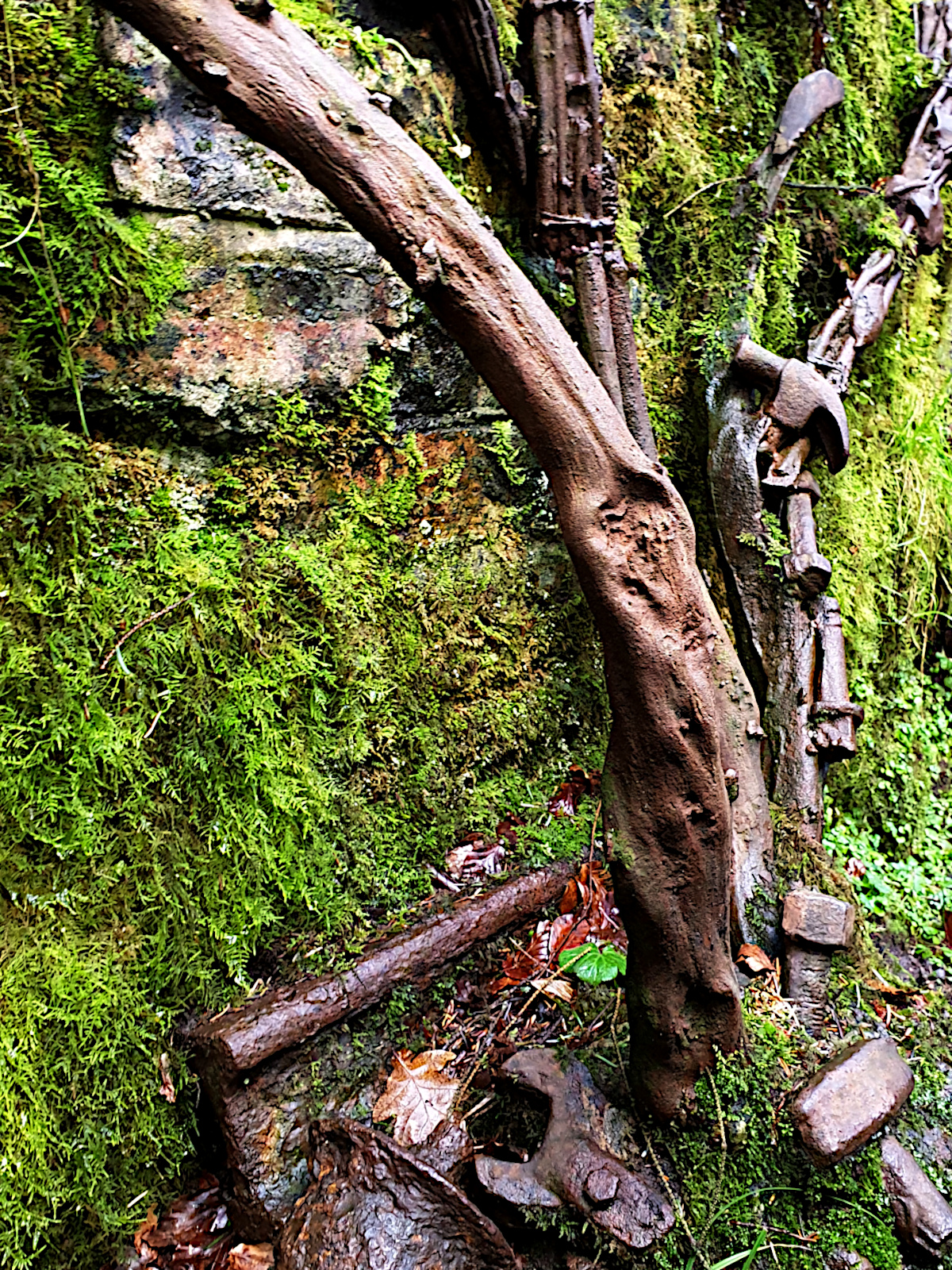
At first glance I’d assumed it was ‘just’ a strange looking tree. When I had a closer look it turned out to be a tree sculpture made of rusty steel (Or plain iron, I suppose.) objects. I assume it has something to do with the area’s mining heritage, but have thus far found out nothing more about it.

Me being me, an iron tree naturally leads to ideas of magic and nonsense. One day, perhaps, I’ll write something set purely in the real world. Although that could be the most fictitious sentence I’ve ever typed.


Arthen scowled as he dragged another ruined tool from the acid bath. Pliers that had been perfectly repairable a day before were now utterly beyond use. He laid the pliers on a towel and dumped a mallet, whose only fault was a cracked handle, in its place.

He carefully rubbed the pliers dry then, as instructed by his master, scuffed the surface with a wire brush until his soul could take no more. Preparations were finally complete. On that poor tortured tool at least. It would rust quickly once it was out of the workshop’s dry heat. He threw the wrecked metal onto the pile of similarly defiled detritus. Feedstock for his masters latest project.

The whole thing was deeply worrying to Arthen. Destroying damaged tools in that manner was dangerously close to heresy in dwarven culture. Already there were grumblings in the nearby revel-halls against Forgemaster Corath. If he was not careful he could be run out of the Delving, excommunicated and exiled from his people.

In principle, Corath’s actions shouldn’t reflect on his apprentice. That was the law. Unfortunately, law and reality were uneasy companions who would ignore each other as much as possible. If Corath were to be cast out Arten would struggle to find an apprenticeship with another Forgemaster. Legally he would be unsullied by his master’s sins, but it would be all anyone could think of when they saw him. He would be ruined.

Wearily, Arthen prepared the Forgemaster’s tools and workspace. Like any master craftsman, Corath insisted on exacting standards at his forge. Outsider’s might think of dwarven workshops as dingy, grimy caves in rough-hewn tunnels within the bellies of the mountains. Well, they were fools. The workshops of a Forgemaster, even in the midst of a Crafting, were clean and tidy enough to make an elven banquet hall seem like a beggar’s hovel.

On balance, while Arthen didn’t approve of his master’s recent methods or his latest project, only one course remained to him. Serve Corthen to the best of his abilities and hope the Forgemaster knew what he was doing. But that was the lot of any apprentice within any Craft.

Forgemaster Corthen entered as Arthen laid the last tool in place. Somehow he always knew the right moment to arrive. Under his arm was a box containing the most valuable treasure in the whole Delving. Dragon Ash. The remains of a fallen dragon, consumed by the fires of his foes and reduced to a fine red powder. A pinch of Dragon Ash would allow a Forgemaster to bestow magical properties on the workpiece during a Crafting.

Corthen approached the forge. He bowed his head and whispered the Crafter’s Prayer. Arthen’s voice joined in heartfelt echo. The next few hours would determine his fate, one way or the other. The end of the prayer died on his lips as he saw what the Forgemaster was doing.

That settled it. Banishment would be a mercy now. Arthen and his master would be lucky to escape with their lives. Corthen had opened the Dragon Ash casket and had upended it into the forge. A supply that large should have lasted for hundreds of years. Surely no creation could be splendid enough to save them now. Yet that was their only hope. In this crime Arthen was complicit — he should have stopped his master, at least limiting the damage if not preventing it entirely. All that remained was to help his master and hope their Crafting was sufficient to redeem them.

The following hours were a blur of hammering and heating, shaping and beating. The ruined tools were further warped. The clean precision of their once crisp lines were slowly wrenched and tortured until they looked organic. One by one Forgemaster Corthen and his apprentice twisted metal into blasphemous shapes and fused them together.

Bitter bile rose in Arthen’s throat as the Forgemaster laid down his hammer and stepped back to admire the form of his creation. They had created a tree. Twisted gnarled so that it almost seemed alive. The pure, sacred surface of metal was pitted and pocked as a tree’s living bark.

“Arthen, the bellows, please lad,” whispered Corthen.

“You’ve killed us both,” was all Arthen could manage in reply.

“Trust me now lad,” said Corthen. “If this works it will change the world. If it doesn’t, I will stand in your defence and take your punishment upon my own shoulders.”

Arthen nodded. His master had given a solemn vow. According to the ancient laws of the Dwarves no judgement could now fall on Arthen for what they had done.

He bent to his duties and drove the bellows. The forge’s fire roared and the temperature soared until it was as hot as dragon fire. Corthen grasped the flame-pipe, a flexible tube of interlocking stone links that would guide the dragon-flame onto the workpiece. With this final step the magic of the Dragon Ash would be activated.

Arthen gasped when he finished his work and looked at last at the completed Crafting. Although the tree appeared unchanged, the difference was somehow apparent. The tree was alive. He watched as the carefully crafted metal flowers dropped their petals one by one. The inner structures of the flowers, a mystery to Arthen until that day, swelled into fruits.

Corthen reached up and plucked one. Grinning like a school-boy he bit into it. A rush of juices escaped his lips and dripped into his beard. Arthen fell to his knees, unsure if he was in awe of the tree or his master.

“If we work no other magic in our lives,” said Corthen, “at least we will have Crafted this. Now we can grow crops within the Delving itself.”

Faltha’s Celebration

Way back when I first wrote Summer Sorcery (in that no-one-else-gets-to-see-ever first draft) I imagined a backstory scene with Faltha and Malachite. There’s a nod to it on p125, but the book didn’t need derailed with the plot-irrelevant personal history between two important but ultimately secondary characters. However what made it into the book planted a mental seed that has been quietly asking to become something ever since.

So here goes. A wee look into one of the events that made Faltha and Malachite who they became…


January 25th 1804…

Faltha swerved between the trees towards Malachite’s ruins. The large bag of supplies swung awkwardly from her clenched hands. It wasn’t that the sack was too heavy for her. She could manage many times its weight comfortably. If put to it she could probably manage all two metres of Malachite’s stone body. The problem was that it swung as she wove her path through the woods. Compensating for its persistent tug in exactly the wrong direction was a chore.

The stone man had been worrying her recently. While he had never been the life and soul of the party, Malachite was seeming even more withdrawn than usual. He hadn’t spoken in three days. Despite Faltha’s best efforts to strike up a conversation. She’d managed to wring a vague grunt from him on Sunday which as far as she knew was the last sound he’d made.

In her opinion, what Malachite needed was a celebration. Nothing too lavish. That would just irritate the poor man. A wee dinner with a few select friends. Perhaps some of that new poetry that was going around. As luck would have it the humans had recently invented the ideal thing. Burns night. With its blend of weird food and fancy new poetry the celebration was perfect for Malachite: an evening filled with new experiences to learn about.

“Malachite!” she called as she entered the clearing where his ruins lay.

He always insisted on referring to them as ‘The Tower’ but with one and a half stories of crumbling stone it was hard to see how that was an appropriate label. A few centuries ago it might have been fair enough and before the wars, when the Wizards had still been in residence, The Tower had been a sight to behold. These days Malachite had managed to maintain a couple of chambers in usable condition. Through sheer stubbornness as far as Faltha could see.

The stone man sat up from his reading and half turned to watch Faltha as she flew to his desk. As she deposited her bag on the table with a solid thud, he sighed theatrically and turned back to his book.

A scowl twisted the tiny faery’s brow. She pushed it away with an effort of will, and only a little glamour. Stropping at him was hardly going to lift his mood. Malachite’s sighs were irritating in the extreme, though. Made of stone, as he was, it wasn’t like he needed to breathe. The sighing was just rudeness for rudeness sake.

“What’s in the bag Faltha?” she asked herself in as deep a voice as she could manage.

“I’m glad you asked Malachite,” she replied in her normal voice. “It’s ingredients. We’re having a wee celebration this evening.”

“Faltha,” said Malachite, “you know very well that I do not eat.”

“No, but the rest of us do.” She was about to start scolding him, but forced back her growing annoyance. “We’re doing something called ‘Burns Night’. We have a dinner with some fascinating new human food. I know you wont eat it, but I figured you’d enjoy learning about new human customs. This things only been going on for a couple of years, but I reckon it’ll last.

“Anyway, after dinner, there’s some poetry by this guy called Robert Burns from over on the west coast. So I hear, he’s all the rage just now.”

“That does actually sound rather fascinating,” said Malachite.

Faltha fluttered down next to her bag. She opened it and started pulling out the contents which Malachite silently intercepted before anything landed on his precious books.

“So we’re having haggis, leeks and tatties,” said Faltha excitedly. “Haggis is really weird. You’ll love this! It’s basically the insides of a sheep, and they stuff it with… uhm, well… they stuff it with something anyway. Then they—”

“I’m sorry, Faltha, haggis, what and tatties?” Interrupted Malachite.

“Leeks.” Faltha pulled a fat leek from the bag and waved it at Malachite.

“It’s neeps, Faltha. Haggis, neeps and tatties.”

The leek stopped mid-swing. “Oh… oops. Uhm, well, we’re having leeks. Our own wee twist on tradition. We can do the neeps next year. Unless the leeks are fabulous, of course!”

“The real question is, where do the eggs feature in tradition?” asked Malachite. “I haven’t heard about that one.”

“Oh, they’re not part of tradition. My sister, Grunda, is terribly fussy, so I thought it best to have a backup plan in case she won’t eat the haggis.”

“Ah, I see.” Malachite seemed disappointed, but there was nothing to be done about it. Making up some fake tradition wouldn’t end well. Faltha wouldn’t go down that route again.

The stone man’s attention drifted back to his books.

“Do you need anything from me?” he asked.

“No you go back to your books, I’ll take care of it all. Just you wait, its going to be great.” Faltha was confident that he’d already stopped listening. That didn’t matter. He’d see. It was going to be great.

She took her supplies out of Malachite’s room and busied herself building a makeshift oven against one of the outer walls. That done she cast about for some firewood. Being January in Scotland most things were damp. Luckily Malachite had built a sort of pergola around the corner from Faltha’s oven. It provided enough shelter that the tangle of thorny twigs within were reasonably dry.

Hacking them out was a task in itself. It took several minutes for Faltha to emerge with enough firewood, triumphant but for a few rips in her dress. A small price to pay to help a friend.

She assembled a fire and, after a few attempts, got it lit. It occurred to her to wonder at that point why Malachite had replaced the beautiful rose garden that he’d had under the pergola with a bunch of dried thorn-bushes. She’d have to ask him some time.

Once the vegetables were all prepared, Faltha placed them in a wide stone bowl that she’d borrowed from the Seelie Court palace. It was of cunning dwarvish design, with a lid that sealed tightly in place. She half filled a second bowl with water and dropped the three dozen eggs in. Obviously they weren’t all for Grunda. Faltha had a few guests joining them and, frankly, she was a bit sceptical about the haggis. She sealed the lid and put both bowls into the oven. That done, she stoked up the fire and set about decorating the ruins to make them seem at least a little inviting.

Evening had set in by the time she was finished sprucing up the place. She nodded to herself in satisfaction. No one could do fairy-lights like an actual faery. The old ruin was looking almost nice. A bit more of this and Malachite might have an actual home.

Her musings were interrupted by an explosion that knocked Faltha back to the tree line. She recovered in time to avoid a collision with an ancient elm. Dust clouded the area around Malachite’s ruins. Faltha felt her blood run cold. She darted back to the ruins to find out what had happened. Presumably some experiment of Malachite’s had gone wrong.

Visibility dropped alarmingly as she approached the ruins. She desperately hoped Malachite was alright. She hovered over the splintered fragments of his desk. No sign of him there. That was a relief. With any luck it meant he had moved away in time. Faltha turned, surveying the damage. The back wall of the room had collapsed inward, covering most of the floor and piled in a heap on the remains of Malachite’s bed.

She jumped as a pair of loose stones shifted and clattered to the ground. Something moved beneath where they had been. Peering through the dust filled gloom Faltha could just make out a hand.

“Malachite!” Faltha screamed as she flew in to help her friend. “Are you alright?”

“I’m fine, Faltha. It will take a little more than a wall collapsing to harm me.” More of Malachite emerged from the rubble as he spoke. “What happened?” he asked as he finally sat up.

“You don’t remember? Poor thing,” said Faltha. “Maybe you’ve come to more harm than you think. Whatever experiment you were doing exploded.”

“Experiment? What experiment?” Malachite sounded confused. Poor thing. “I wasn’t doing an experiment. I’d gone to bed.”

“Oh,” said Faltha. That explained the wall falling inward. The explosion was from outside.

“Faltha,” said Malachite, “by any chance did you cook the eggs in their shells?”

“Well how else would I boil eggs?”

“Not in a sealed vessel, for starters,” said Malachite. “Otherwise they explode.”

“Okay, nice tip,” said Faltha. “If I ever do any more cooking I’ll try to remember. Now shouldn’t we try to figure out what blew up your bedroom.”

Malachite reached behind him and liberated something from the rubble. The cracked remnants of a dwarven cooking bowl. Powdered eggshell was surprisingly identifiable within.

“It’s a mystery,” said Malachite.

“Oh,” said Faltha. “Sorry.”

Beneath

This week’s image is from a trip to Bolsover Castle some years ago. Unfortunately, the only copy I can find of this picture was messaged to me recently by my wife when it came up in her ‘on this day’ gallery. The upshot is that its not the highest image quality thanks to the joys of instant messaging technology.

Regardless, we thoroughly enjoyed our wander around the castle, which contained many wonders beyond the above mildly threatening image. I have a double challenge for this prompt. Firstly, I find the picture strongly evocative of Piranesi, so I need to steer clear of that. (Don’t get me wrong. I like that book well enough. But even if I could emulate it here I, obviously, wouldn’t!) Secondly, I’m home-schooling my kids this week, so writing this is in a snatched window while I subject them to factorisation practice…


The lights flickered, but at least they existed. Oren’s task had been much worse before they were installed. Actually, the worst was while they were being installed. The workmen had used a portable flood-light rig to illuminate the area they were working. Even so, Oren had been sent ahead to clear the way. All the light in the world and yet they sent him in first with nothing but a candle and his wits. Well, those and a sprayer full of salt-water. Stepping out of the workmen’s ring of light into the inky darkness beyond had taken all his resolve.

It was better now. He could see the length of each hall. His task was to dispel the ghosts that haunted the warren of tunnels under the fortress before they built up. Incorporeal though they were, enough ghosts could overrun the castle. Oren was lucky to have the electric lamps, no matter how they flickered. It was easy for a mind, already on edge, to imagine fresh horrors in the unknown darkness. It could drive a man mad.

Oren’s predecessor had been missing for four months when Oren had been appointed to take over. The man’s body had never been found. Of course, it wasn’t impossible that he’d freaked out and ran away into the night. It wasn’t as if anyone checked on the Ghost Warden. Unsurprising, as anyone sane would be safe behind their salt-wards after sundown. Besides, ghosts didn’t accumulate that quickly. The castle had once done without a Ghost Warden for over a year.

A hint of movement captured Oren’s attention. The wispy trail of a spectre led into a side-chamber. Time to earn his comfortable living. Aside from the inherent danger of ghost dispersal Oren’s job was easy. He only needed to work one night per week, and even then there would only be three or four ghosts to disperse. In recompense, he was kept in luxury nearly as lavish as the king’s.

He followed the ghost as the lights dimmed again. He sprayed as they flickered back on. The spectre shredded in the salty cloud, as always in unsatisfying silence. As the light faltered once more, Oren spotted more movement.

Brightness flooded the chamber. Four ghosts burst from the shadows at the back of the room. Oren screamed and unleashed a barrage of spray. The lights blinked out again.

Gloaming

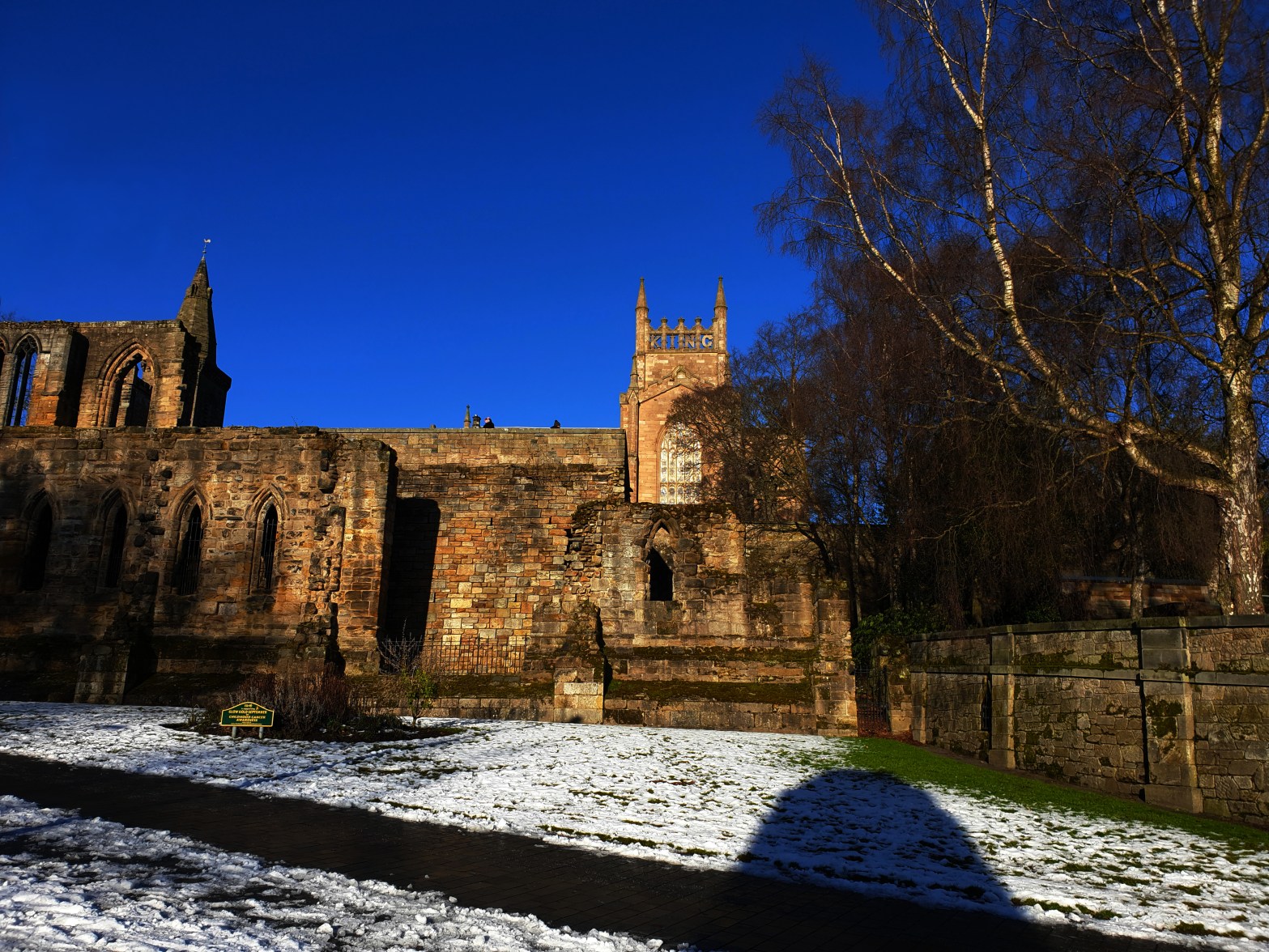
For this week’s story prompt image is of Dunfermline Abbey. It was taken about a year ago, or as I think of it now, the good old days. This year has been a beast so far, and not in the good way. You’ve not come here for the whining though so we’ll leave that be and get on with it.

I must admit to having cheated with the photo a bit. The lighting was nowhere near as atmospheric when I took the picture. Luckily, thanks to digital technology, my photos don’t need to be burdened by such things as the subject existing. There was also a street-lamp that crept in only to be obliterated by a few mouse-strokes. It was alarmingly easy, so I’m resolving (a little late) to never trust anything I see ever again.

On to the story.


The shadows deepened as gloaming set in, loosening the ties that bound me to the cold earth. Moonlight coalesced into a body, of sorts, as a familiar floating sensation overtook me. My annual trip to the land of the living was about to begin.

You might imagine that I’d be excited. That a chance to walk the streets of my youth once more would be a delight to savour. Oh, if only that were true. Unfortunately that was not my reality. Ghosts, you see, aren’t immortal souls given form. No, a ghost is the echo of a body reverberating off the walls of reality. And bodies are imperfect.

Every year on this night a pale shadow of my body forms in the graveyard by the abbey. For an hour as the world retraces is path around the sun I re-tread my own fruitless search. In these endless moments between risings I know the task I must complete to break my curse: I must find my son. Simple enough, you might imagine, yet in the three hundred years since I died I have not succeeded. You see the pale and imperfect spectre of my body lacks mind and memory enough to recall where I gave him up or even what he looked like.

Fingers of moonlight lifted me up through layers of soil and I felt my mind fade as my body took form. In minutes I would wander the graveyard, lost and afraid. Understand neither why I am lost, nor of what I am afraid. Only knowing that there is someone I am missing and that I have left him nearby. Close but, perhaps forever, out of reach.

“Your own…” I start to scream, but my traitor body has forgotten the word ‘son’. It cannot remember his name or his face. It just shambles on. I just shamble on pacing rings around the graveyard until the sun rises to grant me a kind of rest.

Such is the nature of my punishment. On the one hand, incorporeal and fully aware of how to ease my torment. On the other hand, able to act but lacking the faculty to direct my actions usefully. I can sense the knowledge there, like a word escaping from the tip of your tongue. Maddening in its proximity and its absence. Then, like the absent-minded professor forgetting what he’d gone to do and going back to his chair to see if that helps him remember, I return to my grave. I know I will remember as my body evaporates and my mind takes over once more. Unlike that metaphorical professor, I don’t want to remember. But that is my torment. I must live with what I did. Even thought I’m dead, it seems, I must live with it.

Curiosity

Another one from the Highland Wildlife Park archives. This photo, from November 2019, was an opportunistic snapshot as we walked past the snow fox enclosure. I’d actually stopped to tie my shoelace and looked up to see this guy studying me intently. I wonder what he thought I was doing. Perhaps he was just looking for a new friend. Or maybe I looked like an optimistic lunch option.


I awoke to a face-full of snow. Not a promising sign. The last thing I remembered was warming myself by the bonfire where I was burning the last remaining items. Those things that I had neither the energy nor the inclination to pack and move.

Spilled hot chocolate stained the fluffy white ground beside me. I must have fallen asleep while drinking it. I was lucky I hadn’t fallen into the fire. Lucky it hadn’t fallen on me. By the end I was so exhausted there was no building it carefully. The stack of unwanted furniture and my other flammable rejects had stood head-high and it was all I could do to fling the final items into the flames.

I flexed my cold-stiffened muscles, trying to regain some use of them. In the moment I started to lift my head I heard it and froze. A snuffling near my head. I was terrible at judging size from sounds like that. Last summer while camping I’d pattern-matched the nocturnal ramblings of a hedgehog for those of a werewolf. In my defence I knew it wasn’t a werewolf, but my sleep-addled brain refused to offer any other nouns.

Assessed by that standard whatever was sniffing in the snow nearby would be the size of a bear. I tried to think of some less terrifying beast of a similar scale and came up with nothing.

The sniffing intensified. This was it. Sleeping in the snow hadn’t done for me, so nature was finishing the job with tooth and claw.

Panic flooded me, providing an urgency that I’d failed to find last night. I lurched up and backward. First to my knees and then my feet. Fight or flight surged through my veins and I readied myself to make a stand or a sharp exit as new information demanded.

The snuffling something proved to be a small arctic fox. It danced backward, scattering snowflakes everywhere like the plastic flecks in a snow-globe. The fox’s mouth lifted in an entirely non-threatening manner. It snorted twice and I was sure I could see laughter in its eyes.

“Hello,” I croaked. The night had not been kind to my voice.

The fox crouched its front half, leaving its hindquarters and tail in the air. It yipped it eerie-strange bark and jumped excitedly. The sound echoed weirdly from the outbuildings around me.

While I was still reeling at the oddness, the fox darted past me. It came so close to my legs that it brushed off some of the snow that had stuck to my trousers. It trotted up to the edge of the fire, grabbed something from the embers, and dragged it back through the snow.

A pheasant. Thoroughly dead and quite charred. The feathers had been ripped off rather than burned away. Had this curious beastie cooked me breakfast?

The fox sat expectantly by its prize. Its head flicked up to me and back to the food. Back to me again. Its great brush of a tail scudded back and forth in the snow, filling the air with a cloud of dry white ice that hung in the still air.

I hunkered down and pulled off a drumstick. The meat cooked through but deliciously moist. I threw it my new friend before pulling off the other to eat myself.

The fox needed no further invitation. It gulped down the meat then started in on the bone. I wasn’t sure that was a good idea. I know you’re not supposed to let dogs eat chicken bones. On the other hand, the evidence suggested that this fox was significantly more capable than I was right then.

I ate the delicious meat and considered my situation. The fox sat companionably by my side. We both stared past the leftovers of the bonfire. The remains of my old life. I wondered what was next for me. I looked at the fox and he looked right back at me. Perhaps whatever was coming, I wouldn’t meet it alone.

Pocket Dragons

Once upon a time I made computer games. Well, tried to anyway, the venture never really got off the ground. A lucky escape, all things considered, although I didn’t think it at the time. One of the games that I was looking at involved dragons. I’ve always found 3d modelling to be easier with a physical prop to work from, so I bought some air-drying clay and made some dragons. Not very well, of course. I’m no sculptor. Enough to get me going though. It was also something I enjoyed doing, so many more dragons appeared. The one in the picture is one of the smaller efforts. Neatly pocket sized.

Roll on a decade or two (yikes!) and said models were somewhat repurposed. On a family walk my daughter and I got to making up stories and we came up with the notion of pocket-dragons. We kicked around a few ideas and then left it be for a while. The idea has resurfaced again recently, and we might do some kind of joint effort — I’ll let you know if anything comes of it. What follows has nothing to do with what we’ve got planned. Think of it as a different jumping off point for the seed idea. I always enjoy exercises like that. It keep ideas from stagnating.

In the mean time…


It happened again. Something had definitely wriggled in my pocket. I shuddered at the prospects of what that something might be. I’m not good with mice at the best of times. That’s an understatement. I’m full on phobic. No idea why. It’s not like they can do anything to me. Rather the opposite. I could easily kill one by accident. That might be the problem. Maybe its just an epic case of squeamishness.

The something moved again. So forcefully my jacket bounced twice against my hip. I tried to stop my hand trembling. There was nothing for it. I had to get the poor, cursed thing out. Ideally quickly. Definitely away from me.

I lifted the flap of my pocket and the movement instantly stilled. My skin tightened all over. I was going to have to do something to get the whatever out. There was never going to be a comfortable outcome here, but this was not going the way I wanted. Still holding the flap open, I pulled the side of my jacket as far away from me as it would go and gave the inside a tap.

The something wriggled in a most mousy way. Nothing emerged.

I patted it again. Still nothing.

I was going to have to lift it out.

I felt my breakfast threaten a return and clamped my mouth shut to keep it and any co-lurking manly screams in.

Truly I don’t know how I managed to make my hand move. One moment it was trembling by the flap and the next I had plunged it into my pocket. Speed might be my friend.

What my hand met wasn’t furry at all. It was smooth. Hard like a stone. A stone that trembled.

I withdrew my hand. The shakes were gone now that curiosity had the better of me. My hand opened and wonder replaced every other emotion I was capable of. The something was a tiny green dragon. It curled around on itself, like my hand was a miniature treasure hoard that it was guarding.

The dragon straightened its neck and looked up at me, blinking its little brown eyes. There was an intelligence there that I was unprepared for.

Then it spoke in a voice unexpectedly deep. “Don’t eat me,” it said. “I promise it won’t end well for either of us.”

“I… uh… sure,” I managed. Pathetic really.

“Speaking of eating,” it said, “I could do with a snack.”

“Um, okay. Uh. What do you eat?” I asked.

“Steak if you’ve got it,” said the dragon. “Rabbit will do if you don’t.”

“I don’t actually eat meat,” I said. “Sorry.”

“Huh,” said the dragon. Its brow furrowed like it was wrestling with the notion of vegetarianism. “Well, I guess we’ll have to fix that.” said the dragon.

It drew a deep breath and puffed a glittering cloud at my face. As the vapour touched my skin it suddenly dragged itself in, like spilled milk into a micropore cloth. I coughed reflexively. When I could breathe again I was filled with an overpowering hunger. For meat.

I wrestled with the urge. It had been years since I’d eaten animal, and I wasn’t about to change that now. No matter what my new friend had done to me. Wait. Friend? Surely not. It had done something to me. I couldn’t be my friend, could it? And yet I couldn’t deny how I felt toward the creature. Fondness. A little bit protective. And an urge as strong as need to please it. Was this some enchantment the creature had put on me? I knew that it probably was, but even then I didn’t care. I was its human as much as it was my pocket-dragon.

“Okay,” I said, “let’s go get some lunch.”

Wizard and the Imp Location #2 – The Faerykirk

For as long as I can remember one of my favourite things has been finding out that places in stories are real locations that can be (theoretically at least) visited. Of course, as a dyed-in-the-wool sci-fi fantasy fan you can imagine how often I stumbled upon the places that I’d read about. Annoyingly, the woods of Lothlorien, the islands of Earthsea, and the palace at Cair Paravel have always been beyond my travel budget. I’m rather more glad I’ve never stumbled upon Winterfell, nor detoured via the deserts of Arrakis. I’m rather more torn about never reaching the Six Duchies, or voyaging the stars in GSV Unfortunate Conflict of Evidence. Bad stuff happens there, but what incredible ‘theres’ to be in.

Such scarcity only makes the rare finds sweeter. You can imagine my delight at finding the fairy flag in Dunvegan Castle. Doubtless, one day I’ll make my way to Tintagel castle or any of the other Arthurian sites.

Naturally, the chance to include real-world locations in my own stories is one I can’t miss. That’s not to say that I’ve gone out of my way to shoehorn a place into the narrative. To be clear, that probably isn’t beneath me, just that I haven’t needed to so far. Usually these things have a way of coming up by luck rather than judgement or intent.

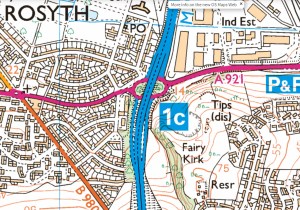
Fairykirk Quarry was one such happy accident. I was deep in the throes of the first draft of Summer Sorcery and trying to come up with a decent setting for the final showdown. In the waiting-room at my GPs is an OS map on the wall covering the local area. I’m a sucker for maps so there was no resisting having a look. In the bottom right hand corner were the words: Fairykirk Quarry. That was something I clearly couldn’t ignore. For those of you not in the know, in Scotland kirk is a small church.

You might imagine, as I did, that the place would be rife with local folklore. I fell on the internet hungrily and… came up with nothing. I try to never let research get in the way of telling a story, so I put it aside and got on with my draft. At the time my kids were young so I had less disposable time on my hands, so visiting was not quite a viable option. I did the best I could with satellite images and maps. Thank goodness for Ordnance Survey!

I did my best to ignore the fact that the M90 was irritatingly near. For all that Summer Sorcery is set in (approximately) modern Scotland, I had no particular desire to include traffic noise in the background, or have armies of goblins navigating trunk roads.

Some years ago at an event in the Edinburgh International Book Festival, an author offered the opinion that any location in a novel, even a real-life location, was for purposes of the book a made up place. As such, the setting needed to fit the story more than it needed to match aerial photos. I took this as licence to muck around with the Fairykirk to my heart’s content.

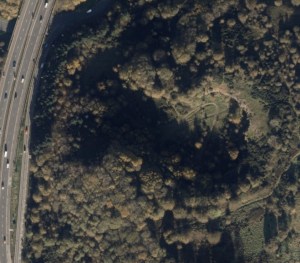
To the right is the OS satellite image of the quarry. Not a lot to go on, but enough. A north-west facing horseshoe shaped quarry with a good portion draped in shadow. I could work with that.

I threw in what I could and made up the rest to suit me. Then I got on with the endless redrafts, and the next books, and made a mental note to visit the quarry when I had a moment.

It doesn’t take a genius to point out that ‘when I’ve got a moment’ is a largely mythological concept. It has use for procrastinating, but precious little function as a planning strategy. In fact it took me until this year to make the short trip. What I found was both better and worse than what I’d hoped for. Which I’ve come to learn is always what I should expect.

binary comment

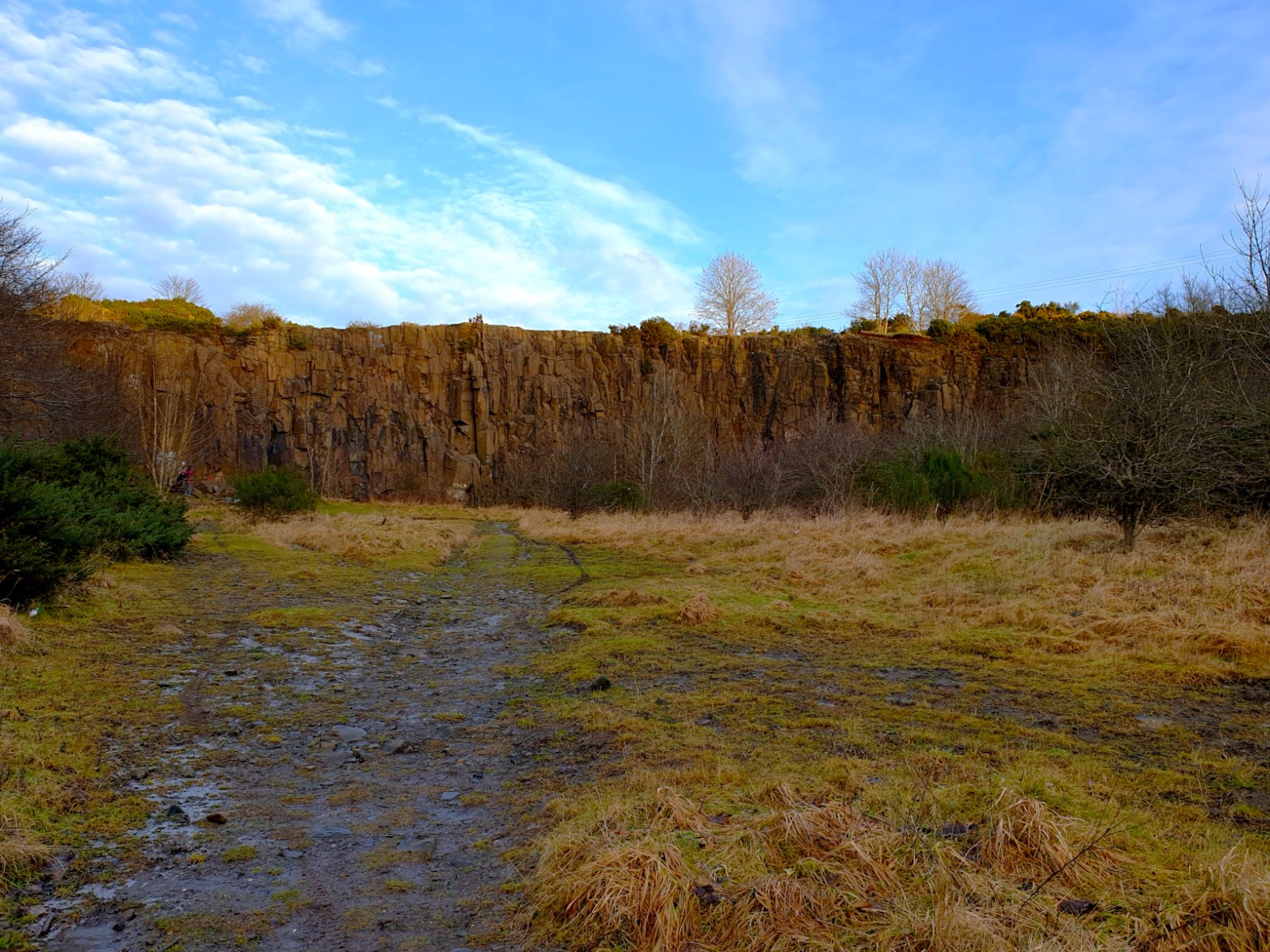
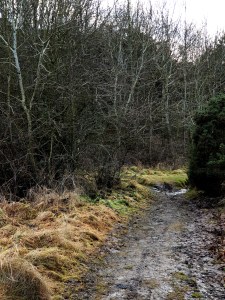
The picture to the left is the final approach path to the actual quarry. The rest of the ‘path’ from the main road (the A921 marked on the map) was too overgrown for me to realistically wrestle my camera out. The route was a scramble up a surprisingly steep muddy slope through thickets of gorse and dense tree cover. Not quite what I’d had in mind. On the up-side: at least it was suitably secretive. You could easily hide a clan of goblins, and indeed historically a whole faery court.

The undergrowth overgrowth situation also cut the road noise from the motorway to effectively nothing. A definite plus.

binary comment

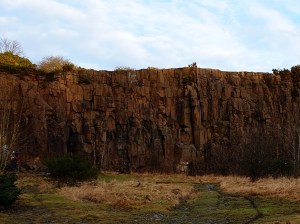
Once I made it through the trees the whole site opened up to a wide rock face. Not withstanding the climbers lurking behind a tree it was exactly what I needed. It doesn’t take a wild leap of imagination to put a magically concealed front gate to a faery fortress in that cliff.

What I hadn’t appreciated from the aerial images was just how long the rock wall was. Perhaps I’m just bad at reading maps. I mean, I could see it formed around three-quarters of a circle. Somehow the visceral effect had escaped me until I was physically there. After breaking out of the woodland there was a real sense of being surrounded. Equal parts shielded, and cut-off from the outside world. Trapped within the influence of the fortress.

binary comment

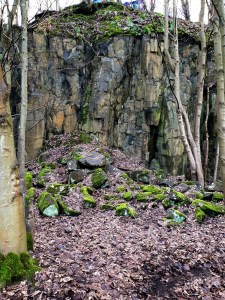
Its not hard to imagine a concealed watch-outpost hidden in the cliff among the trees near the mouth of the quarry. A squad of goblins could easily lie in wait there, ready to spring a trap on an unwary wizard or imp that happened in on an ill-considered rescue attempt.

Unlikely though it seems given how well Fairykirk suits its fictional purpose, it was once a working quarry for… stuff. So while I’d finally put to rest the matter of what it was actually like there, I still had some outstanding business with the quarry: the true history of the site. Whenever I’m overlaying fiction on reality I like to have an idea of what I’m replacing. Not for any good story-craft reason. Just because I’m curious.

Unfortunately, that was where I ran into difficulty. More or less the only item I could find was a reference to the Rosyth Quarry Company Ltd on geograph.org.uk. Apparently the company was wound up in 1961, and I haven’t yet found out any more on that.

In terms of what was quarried there, the best information I’ve found is from a government report on the geology of the area from when the Queensferry Crossing was in planning. Apparently there is a bunch of limestone, which is unsurprising considering the number of limekilns around here, including the village of that name. Other sources suggest that dolerite, a volcanic rock and a form of basalt, was (and still is I think) quarried in the area for use in making roads.

What the site was before that remains a mystery. At least to me. Fife being the magical place that it is, I’m sure there is some local mythology in which faeries of some kind met in what it now Fairykirk quarry and did, well, whatever faeries got up to back then. If anyone knows (or frankly just wants to make up) more history of the place, I’d be delighted to hear from you!

The Invading Dark

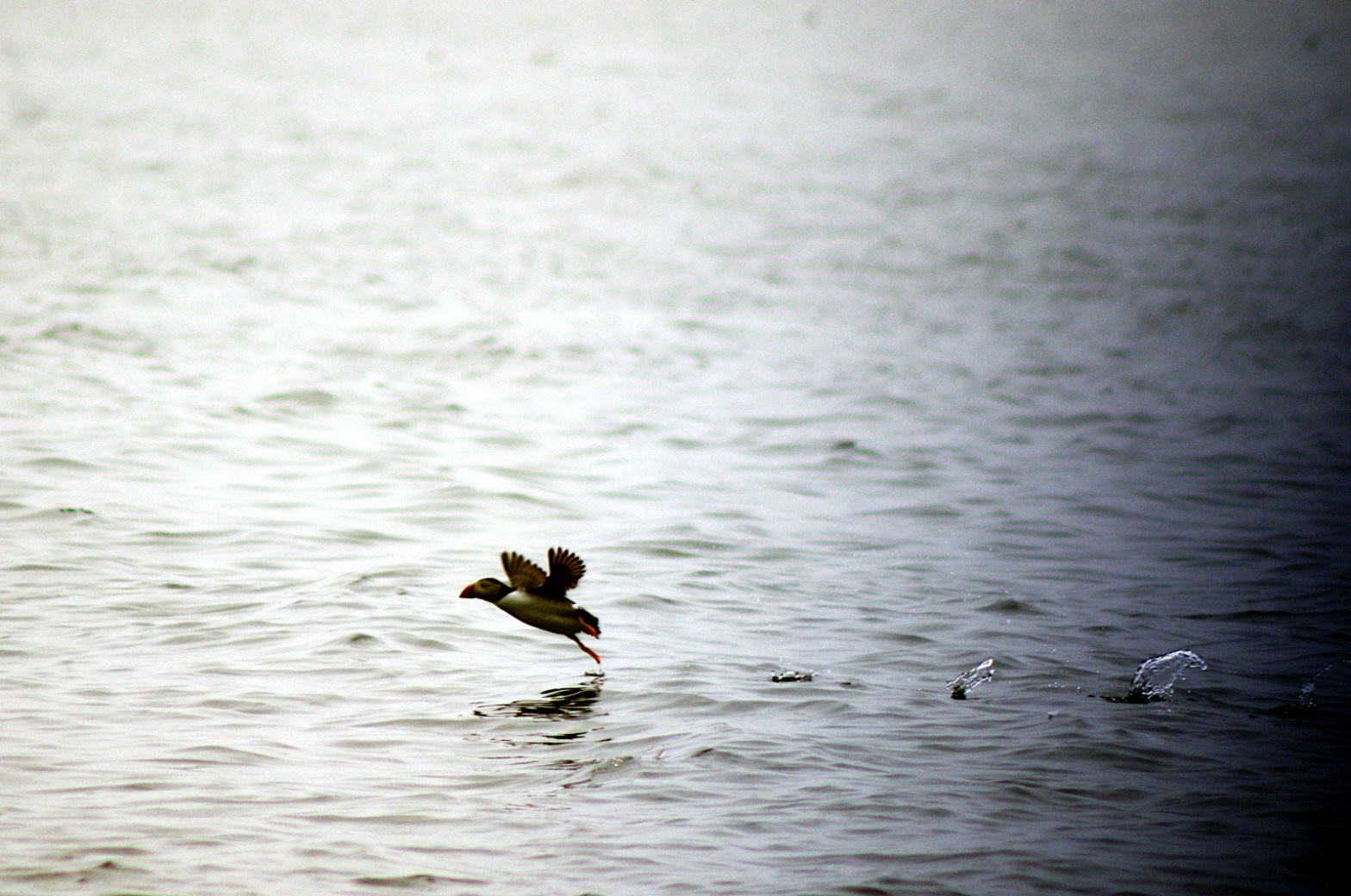
This week’s story prompt image harks back the Isle of May Trip earlier this year. In all honesty the photo wasn’t taken with the intent of using it for anything. I was trying (with minimal success) to get better at catching moving subjects. This one was on the boat-ride in. The fog-laden air progressively filled with birds. I’m not entirely sure what’s going on with the invading band of darkness. For readers of a nervous disposition, I promise it wasn’t there to the naked eye. Thinking about it, perhaps that makes it worse.


Izzy stood on the cliff edge and gazed out to sea. In the distance a solitary puffin struggled out of the waves. Its little feet slapped frantically against the water giving its wings an extra boost to keep it ahead of the roiling darkness that followed close behind.

It was enough. Just. The puffin took to the air. Its wings flapped frantically as it flew for safety. Izzy smiled. She knew it would make it.

She tightened her grip on her staff, drawing comfort from the gnarled patterns carved onto the surface. The Darkeness was nearly upon them. It would soon be time.

In other cultures, all around the world, there were festivals of lights. Ceremonial lightings of decorations. Traditions of lighting lamps and candles. The meanings were various. Frequently religious. Occasionally cynically commercial. Sometimes highly specific. In other places vague, the origins lost to the depths of history. But always lights. Always now.

For Izzy and her people, on the last island at the edge of the world both traditions and lights were as tangible as the great wall of dark that loomed over the sea. This darkness was not that of night. It was thicker. Stifling and dense. It was Darkness incarnate. For centuries, Izzy’s people had stood against it. The Cult of Candles. That was the name that legend had given them. Stupid, really. It made Izzy and her sisters-in-light sound crazy. Which was unfair. Among her sisters there was no fanaticism. No arcane belief systems. Only one ritual. Barely even that, when it came down to it. Just this.

The Darkness rolled over the sea, clipping the breakers as they began to roll over the shallows. Izzy raised her staff and planted it in the loose gravel at her feet.

“I stand. A light against the dark.”

Yellow fire sparked at the staff’s peak. No heat, just a flickering glow. It seemed too small against the mass of blackness that approached. It was.

“I stand separate. A candle against the night.”

Along the headland more candle-flames lit. The Darkness slowed.

“Separate, but not alone. Together we stand. The candles against the Darkness.” On the final phrase Izzy’s took on echoing layers of harmony. Her voice joined with her sisters-in-light. She loved that part. Her heart soared with it. The many candle-flames flared bright. The Darkness stopped. Bound in place.

Power thrummed from the Earth into the staff to feed the cold flame. Izzy felt it take hold as the staff grew roots. It would hold itself aloft and alight until the spring, when the Darkness would once again recede. Her job was done.

Izzy stepped back. A sharp sound froze her in place. It couldn’t be. Could it? In over a thousand years this had never happened. Not since the Dark Days before the first sisters-in-light formed the original Cult of Candles. In all that time no staff had ever faltered.

But there it was. The top of her staff had cracked. The tiniest glimmer of light leaked in a hair-thin line from the apex a hand-span downward. Izzy looked on in horror as the fissure widened.