For as long as I can remember one of my favourite things has been finding out that places in stories are real locations that can be (theoretically at least) visited. Of course, as a dyed-in-the-wool sci-fi fantasy fan you can imagine how often I stumbled upon the places that I’d read about. Annoyingly, the woods of Lothlorien, the islands of Earthsea, and the palace at Cair Paravel have always been beyond my travel budget. I’m rather more glad I’ve never stumbled upon Winterfell, nor detoured via the deserts of Arrakis. I’m rather more torn about never reaching the Six Duchies, or voyaging the stars in GSV Unfortunate Conflict of Evidence. Bad stuff happens there, but what incredible ‘theres’ to be in.
Such scarcity only makes the rare finds sweeter. You can imagine my delight at finding the fairy flag in Dunvegan Castle. Doubtless, one day I’ll make my way to Tintagel castle or any of the other Arthurian sites.
Naturally, the chance to include real-world locations in my own stories is one I can’t miss. That’s not to say that I’ve gone out of my way to shoehorn a place into the narrative. To be clear, that probably isn’t beneath me, just that I haven’t needed to so far. Usually these things have a way of coming up by luck rather than judgement or intent.
Fairykirk Quarry was one such happy accident. I was deep in the throes of the first draft of Summer Sorcery and trying to come up with a decent setting for the final showdown. In the waiting-room at my GPs is an OS map on the wall covering the local area. I’m a sucker for maps so there was no resisting having a look. In the bottom right hand corner were the words: Fairykirk Quarry. That was something I clearly couldn’t ignore. For those of you not in the know, in Scotland kirk is a small church.
You might imagine, as I did, that the place would be rife with local folklore. I fell on the internet hungrily and… came up with nothing. I try to never let research get in the way of telling a story, so I put it aside and got on with my draft. At the time my kids were young so I had less disposable time on my hands, so visiting was not quite a viable option. I did the best I could with satellite images and maps. Thank goodness for Ordnance Survey!
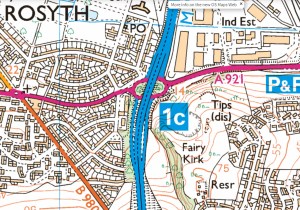
I did my best to ignore the fact that the M90 was irritatingly near. For all that Summer Sorcery is set in (approximately) modern Scotland, I had no particular desire to include traffic noise in the background, or have armies of goblins navigating trunk roads.
Some years ago at an event in the Edinburgh International Book Festival, an author offered the opinion that any location in a novel, even a real-life location, was for purposes of the book a made up place. As such, the setting needed to fit the story more than it needed to match aerial photos. I took this as licence to muck around with the Fairykirk to my heart’s content.
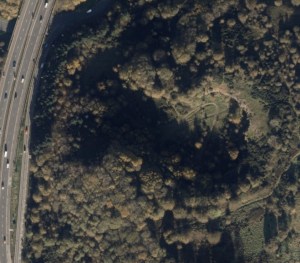
To the right is the OS satellite image of the quarry. Not a lot to go on, but enough. A north-west facing horseshoe shaped quarry with a good portion draped in shadow. I could work with that.
I threw in what I could and made up the rest to suit me. Then I got on with the endless redrafts, and the next books, and made a mental note to visit the quarry when I had a moment.
It doesn’t take a genius to point out that ‘when I’ve got a moment’ is a largely mythological concept. It has use for procrastinating, but precious little function as a planning strategy. In fact it took me until this year to make the short trip. What I found was both better and worse than what I’d hoped for. Which I’ve come to learn is always what I should expect.
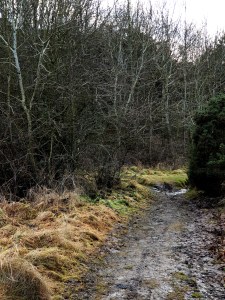
The picture to the left is the final approach path to the actual quarry. The rest of the ‘path’ from the main road (the A921 marked on the map) was too overgrown for me to realistically wrestle my camera out. The route was a scramble up a surprisingly steep muddy slope through thickets of gorse and dense tree cover. Not quite what I’d had in mind. On the up-side: at least it was suitably secretive. You could easily hide a clan of goblins, and indeed historically a whole faery court.
The undergrowth overgrowth situation also cut the road noise from the motorway to effectively nothing. A definite plus.
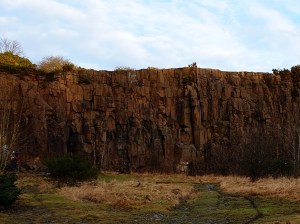
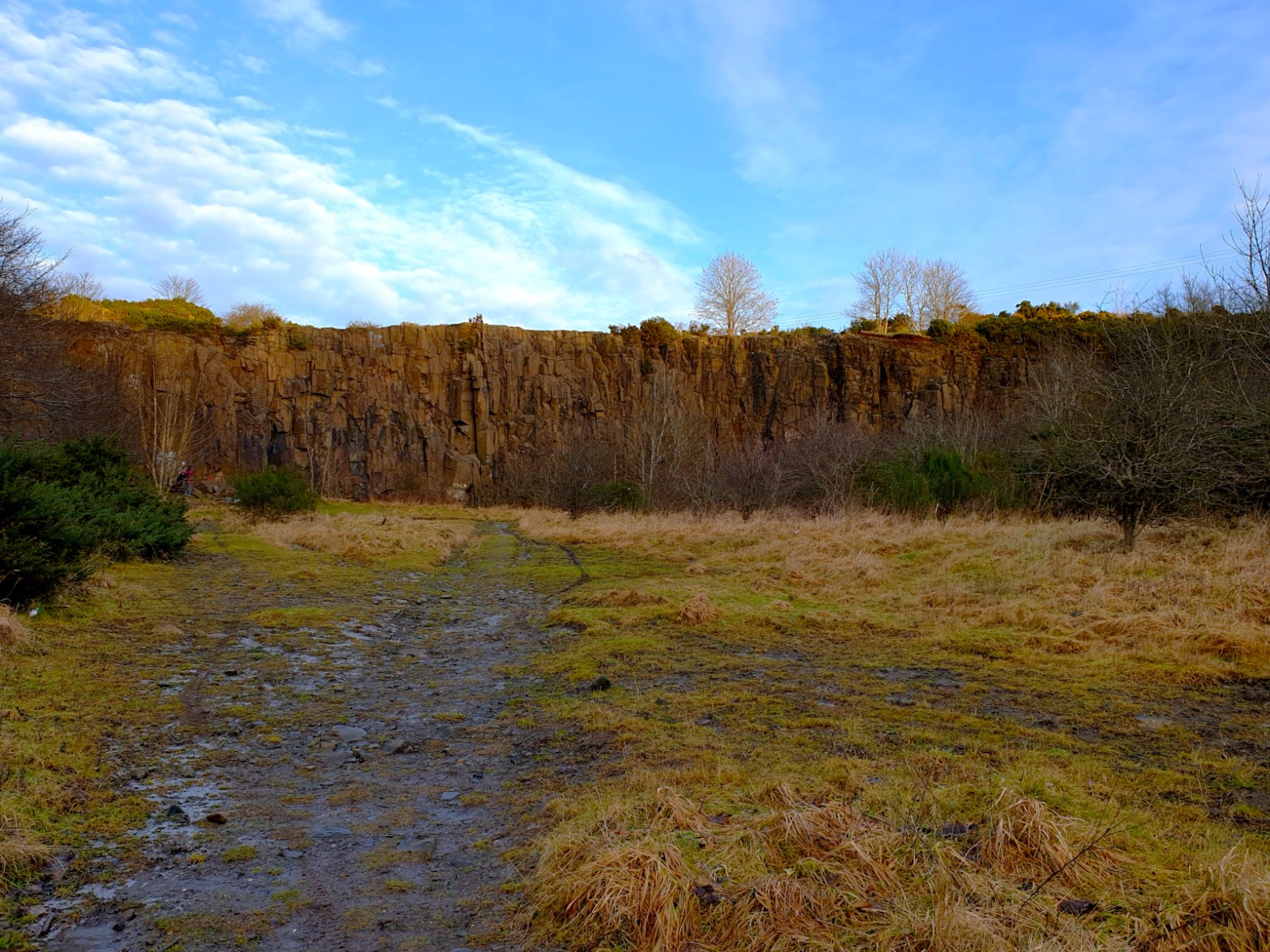
Once I made it through the trees the whole site opened up to a wide rock face. Not withstanding the climbers lurking behind a tree it was exactly what I needed. It doesn’t take a wild leap of imagination to put a magically concealed front gate to a faery fortress in that cliff.
What I hadn’t appreciated from the aerial images was just how long the rock wall was. Perhaps I’m just bad at reading maps. I mean, I could see it formed around three-quarters of a circle. Somehow the visceral effect had escaped me until I was physically there. After breaking out of the woodland there was a real sense of being surrounded. Equal parts shielded, and cut-off from the outside world. Trapped within the influence of the fortress.
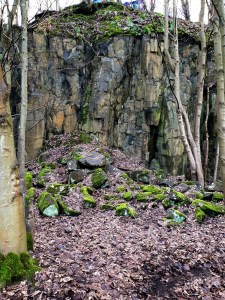
Its not hard to imagine a concealed watch-outpost hidden in the cliff among the trees near the mouth of the quarry. A squad of goblins could easily lie in wait there, ready to spring a trap on an unwary wizard or imp that happened in on an ill-considered rescue attempt.
Unlikely though it seems given how well Fairykirk suits its fictional purpose, it was once a working quarry for… stuff. So while I’d finally put to rest the matter of what it was actually like there, I still had some outstanding business with the quarry: the true history of the site. Whenever I’m overlaying fiction on reality I like to have an idea of what I’m replacing. Not for any good story-craft reason. Just because I’m curious.
Unfortunately, that was where I ran into difficulty. More or less the only item I could find was a reference to the Rosyth Quarry Company Ltd on geograph.org.uk. Apparently the company was wound up in 1961, and I haven’t yet found out any more on that.
In terms of what was quarried there, the best information I’ve found is from a government report on the geology of the area from when the Queensferry Crossing was in planning. Apparently there is a bunch of limestone, which is unsurprising considering the number of limekilns around here, including the village of that name. Other sources suggest that dolerite, a volcanic rock and a form of basalt, was (and still is I think) quarried in the area for use in making roads.
What the site was before that remains a mystery. At least to me. Fife being the magical place that it is, I’m sure there is some local mythology in which faeries of some kind met in what it now Fairykirk quarry and did, well, whatever faeries got up to back then. If anyone knows (or frankly just wants to make up) more history of the place, I’d be delighted to hear from you!
 Brandon Lim