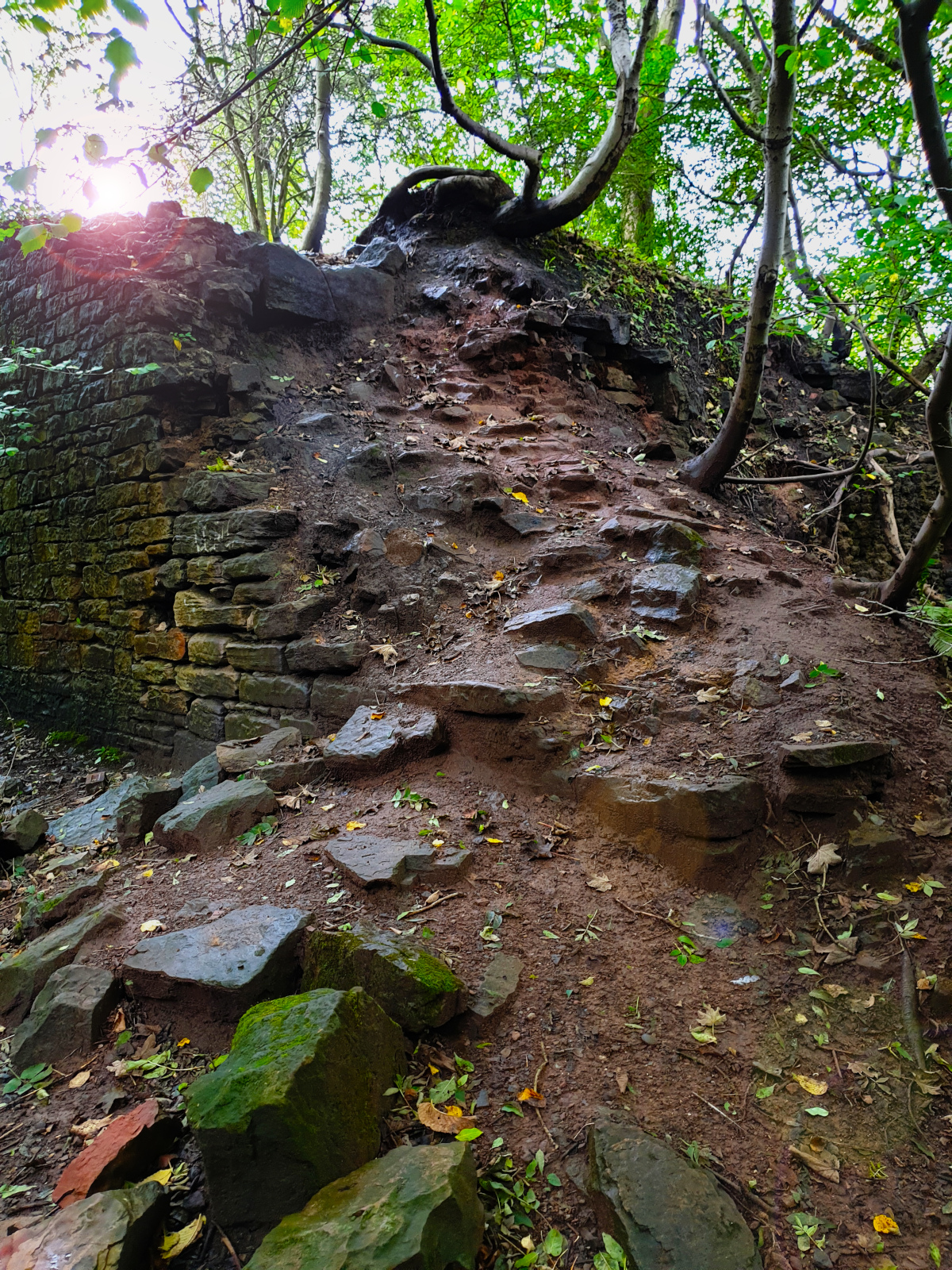
This month we’ll take a look at the site that was my inspiration for the Tower of Sorcery.
Calais Muir Wood is a small patch of woodland about (34 hectares, which apparently counts as quite big these days) on the eastern edge of Dunfermline. It’s been something of a lifeline over the last 18 months as a wild space to lost in for a while but I’ve delighted in dragging the kids around it since they were old enough to walk.
Where it all began
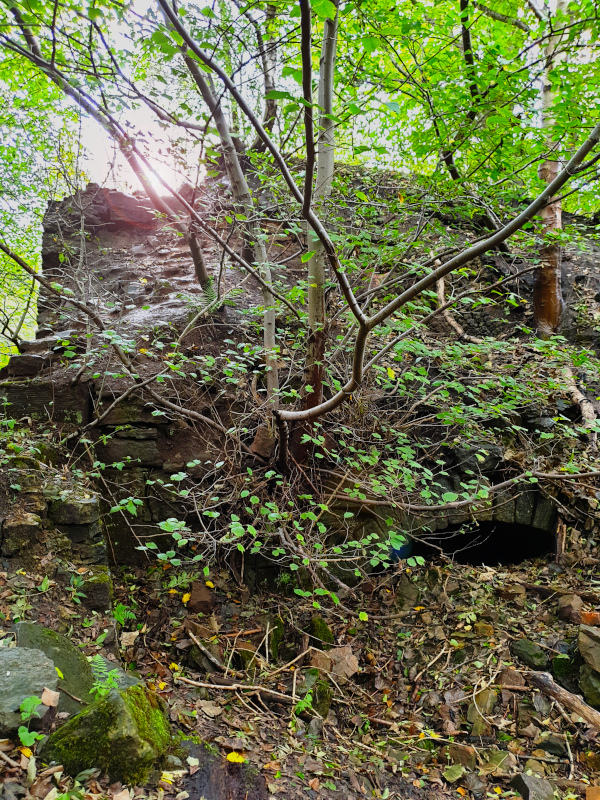
Way back then my daughter’s favourite request was “Tell me a pretend story, Daddy.” Naturally, reading one wasn’t good enough, it had to be a story that I’d made up on the spot. It was during one of these impromptu story sessions that we stumbled upon a ruined structure.
After playing on it for a while it was time for me to continue with the tale. Like a drowning sailor I clung to what was around me. The heroes of the tale, a young wizard girl and her impish brother, came across a ruined tower and rebuilt it as a Tower of Sorcery.
Something obviously captured their interest (thank goodness) as they asked me to re-tell it again and again. As is the way with these things the tale morphed and grew as I shamelessly embellished and revised it. Eventually we ended up with Summer Sorcery (and the rest of the series) as we know it today. In a very real sense you could say that the whole thing started right there at the ruins.
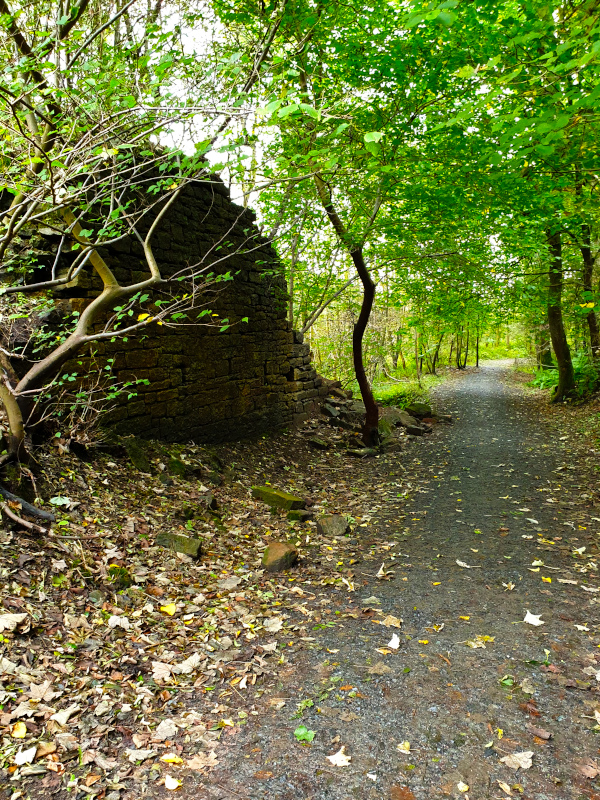
Of course, the Tower of Sorcery in the book is nothing like the structure in the woods. Even the ruins in the story bear little more than a passing resemblance to what you can see in the actual woods.
Imagination furnished me with the curving walls, the enormous door, the wide clearing around the ruins, and the dozens of other features that were needed for the fictional tower to work. Even then a bit of judicious retconning was needed to take the story where I wanted, and the architecture of the tower was not immune.
In the brick
I have a pretty visual imagination and I can usually call up my creations with near-hallucinatory clarity, a trait that served me well over the years. (Back at university it was like having a set of cheat-notes that only I could see.) However, I quickly found that my head-space was just a little too fluid to sustain the detail and topology of the Tower of Sorcery. It was too easy to skew everything to suit the needs of whichever paragraph I happened to be working on. Not really good enough. What I needed was a prop. Something physical that could serve as an anchor to stop descriptions and directions drifting.
Enter the LEGO brick. I am an utterly shameless AFOL (Adult Fan of LEGO), so you can imagine my joy at the notion that building a model could be meaningfully described as work! You know that thing people say about stuff that seems to good to be true? Yeah. Some fool got fixated on a round tower, didn’t he? Not so easy to build, it turns out. After a dozen or so abortive attempts I kicked the project to the back-burner where it belonged and wrote a bunch of notes about the tower instead. Like any sane person would. Like I should have done all along. However…
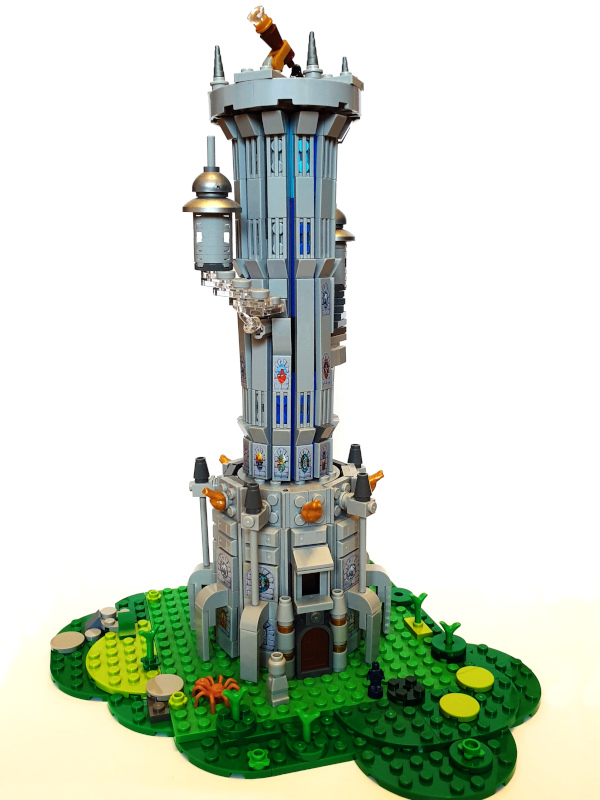
It got there in the end. At least, I think so. Complete with the ‘floating’ Turret of the WInds. I’m half-way tempted to paint or otherwise decorate the micro-figures to look a bit more like Malachite, Nyree and Elias. On the other hand that’s not a very LEGO solution.
It’s not perfect, and I suspect I’ll end up revising it again a few times, but for now I’m fairly pleased with it.
Building it also wasn’t a complete waste of time from point of view of the books. While commissioning the cover art I ended up sending the artist some photos of the model. So at last: a LEGO model as work! Living the dream.
Straying toward the truth…
All that fiction and imagination is fair and good, but what of the actual ruins? After all, they weren’t just put there for my benefit. It also strikes me as unlikely that I’d strayed within driving distance of the truth with my wizard’s tower.
So what actually was all that stonework doing half buried at the edge of the woods? I asked about in all the wrong places and got very little in the way of meaningful answers. In my defence, I’m a child of the 80’s I don’t always think of searching online before I’ve run out of other routes.
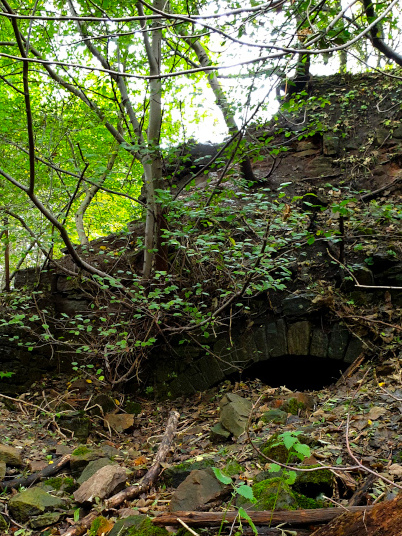
Now that I’ve learned the truth (thanks Google) I feel like I could have guessed really, given the visible structures and local history.
The path you can see in the photo a couple of sections ago runs along the track-bed of the old Halbeath Railway, which hints at an industrial purpose.
The structure is in fact an abandoned and partially back-filled lime kiln. Unsurprising really given that such things were so common around here that there’s even a town called Limekilns. Apparently the site was in use in the 19th century. As with all such things, I’m torn between delight at knowing what it actually was, and disappointment that it didn’t have a grander or more exotic purpose.
Okay, but where?

Fair enough. In case anyone wants to head out into the almost-wilds and see the place for themselves, Calais Muir Woods is at the eastern side of Duloch Park in Dunfermline, and can be accessed by paths from the back of the Duloch Sports Centre. For anyone who doesn’t fancy wandering through the woods hoping to stumble upon ruins there’s a suitably odd way to find it.
There’s an app and website called What Three Words which has divided the world up into 3mx3m squares. Each one is specified uniquely with three words. It’s linked to GPS so you can navigate to it fairly straight forwardly, so long as you know the magic words. In this case those are…
taps slippery operating.
So if I one day encounter someone wandering through the woods, waving their phone around and muttering nonsense, I will know why. We can nod sagely at each other and know that we are seekers of the Tower.
Next time…
Next time I’ll take a look at the other major location in Summer Sorcery: the Faerykirk, which is also a real place. In a more distant future we’ll go to Mackrie Moors, Fortingall, Balfarg Henge, and many other places. But I suppose I should get those books published first.
 Brandon Lim