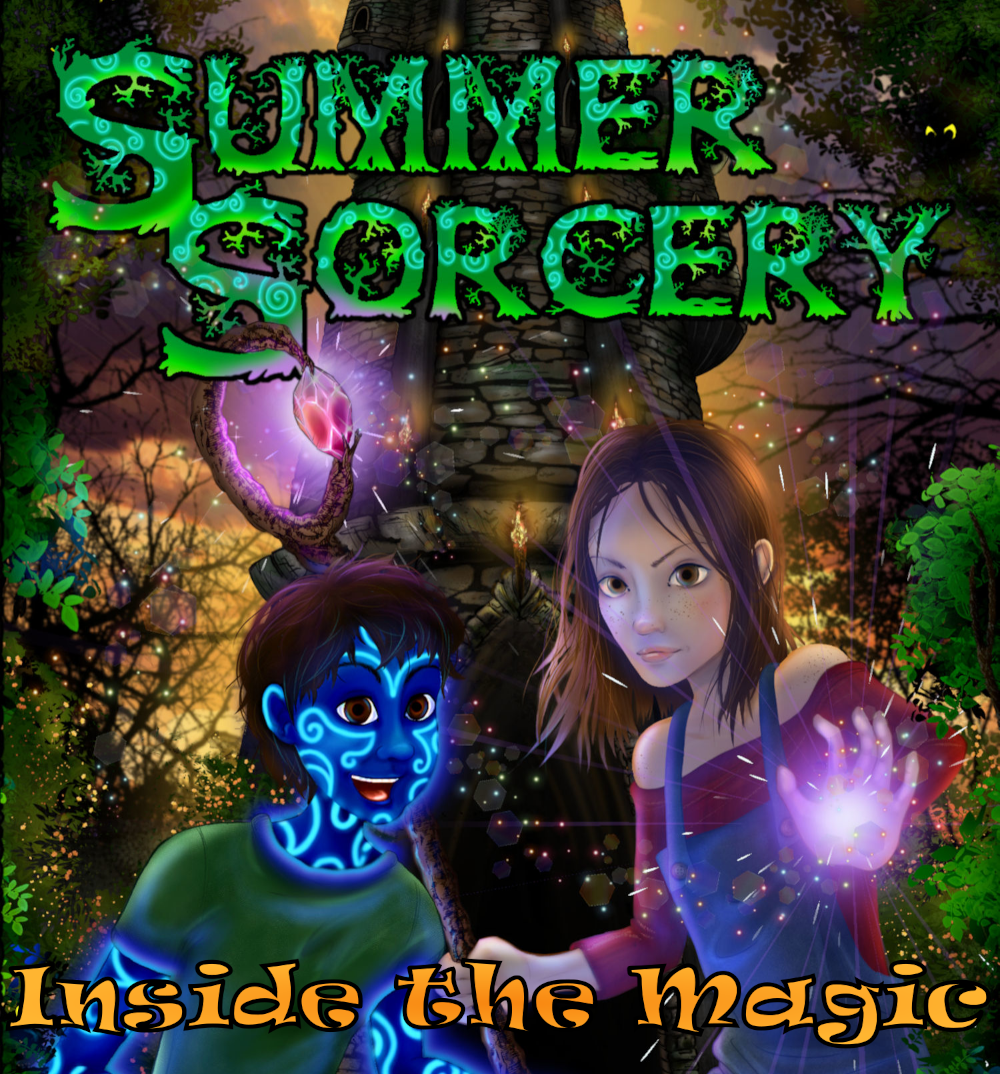
As with many fantasy stories, magic is at the heart of Summer Sorcery (and the rest of The Wizard and The Imp series). Like most elements in story-craft, magic is something of a double-edged sword. Undoubtedly it is an excellent way to inject wonder into a tale, and wonder is one of the main currencies that story-tellers trade in. The flip-side is that it is equally easy for magic to break the wonder that it was supposed to create.
As a child I remember encountering stories that left me thinking ‘why can’t they just cast a spell to <insert relevant solution here>?’ The answer, sometimes, is ‘because it would ruin the story.’ Fair enough, but that’s almost as pathetic a reason as ‘he woke up and it was all a dream’. We can do better than that. Better answers might be of the forms:
- Because magic has a cost, or
- Because she doesn’t know that spell, or
- Because magic doesn’t work that way.
Now we’re getting somewhere. What all those answers have in common is that the magic is constrained. Without those constraints we are at the mercy of the Deus ex Machina consigning our stories to the drivel-bin. In some stories these constraints are central providing, or at least informing, the central conflict that the main character is to overcome. In others the constraints are more coincidental, preventing the characters from running amok and ruining the drama.
Before we jump into how magic sits within the world of The Wizard and The Imp, let’s take a look at how else it might have been.
The Three Wishes and other omnipotences
Harking back to folklore and other antiquities tales in which an ordinary person is granted wishes by some supernatural agent, be it a genie (Aladdin), a fairy (The Three Wishes), or some artefact (wishing wells and the like). In tales such as these the magic is itself practically unbounded. With wish magic practically any outcome, situation, or possession can be requested and granted.
On the face of it, that sounds fairly unconstrained, but on closer inspection that’s not the case. Firstly, the wishes are usually constrained in number. Typically wishes in stories come in threes. (Or are there stories out there like ‘The 67 Wishes’?) I’m sure there’s a good reason for that special number hiding within literary analysis, and if not there’s likely a neuro-cognitive cause lurking in the background. Whatever the number the important point is that the only thing standing between our hero and happily ever after is that our desires are generally infinite whereas our opportunities are far more limited.
In some narratives, the devil is in the details. Classic warning tales of being careful in what is wished for fill countless story books. Each one relates the tale of the intention of the wish being twisted to the granting entity’s will because the words of the wish are not carefully considered. The limit on the magic is nothing less than the cleverness of the wisher. Unfortunately for the poor woodsman who doesn’t think before he speaks his longing of a delicious black pudding.
Introducing constraints
In a good deal of fiction the magic is not limited by occurrence. Indeed it is frequently abundant. In stories such as the Harry Potter series characters are able to cast spells as often as they like. Magic in Tolkien’s Middle Earth is both more pervasive and more mysterious, being embodied by elves and ents, but only directly wielded rarely and only by singularly powerful characters.
In both cases although magic is abundant, we also get the impression that it operates within boundaries. It is never the case that Gandalf can raise his staff, nor Harry his wand, and cast a mighty spell that in one fell swoop solves all their problems. Gandalf’s magic use seems largely limited to lighting things up or setting them on fire, while Harry is constrained by which spells he knows.
Even with just these examples we get a division between inherent limits on the magic itself and the personal limits of the caster. That line is not a hard one, indeed Tolkien strayed back and forth across it. Consider Galadriel’s scrying magic and Gandalf’s fire magic but then contrast it to the seeing-stones (Palantir), and indeed the various rings of power, which can only be used fully by those with enough strength of will/wisdom/natural potency.
Magic in the Potterverse seems to come down on the personal limits side of the equation. The sorcery itself seems entirely unbounded — anything is possible, so long as the wizard has the strength of character to cast the spell.
We see a similar model in the Dragonlance stories. For better or for worse, these books are based on adventures within a role-playing-game. In this case the Dragonlance variant of Dungeons & Dragons, though there are other D&D settings that have made it into narrative fiction. Because this gaming origin, the limits on spellcasting has to be more mechanistic, though possibly more contrived seeming. Here spells can be cast at most once per day. There’s a whole thing about the words burning out of the caster’s mind as the spell is formed. It always seemed to me that Hickman and Weis, the series authors, didn’t care for that artificial limiting mechanism: they also added that spell work took a physical toll, leaving the caster exhausted through too much magic.
Personally, I rather like the notion of magic coming at a direct and immediate cost. It seems both good storytelling and a manageable and extensible mechanism. Great feats can be achieved if the sorcerer is willing to pay the (equally great) price. To me, this is the crux of good fiction — make your choice and suffer the consequences, or just walk away and live with what follows.
Systematic Magic
As a recovering engineer, one of my favourite limiting mechanisms is systematic magic. In this, the magic is not merely constrained by a few limiting factors. Instead the magic ‘works’ in some predictable, or at least understandable manner. A set of rules exists that would allow the reader to figure out what is possible and what is not within the story world.
This is something you see a lot in non-children’s fantasy. Well, I do at least! Walk into your favourite (independent, naturally) bookshop and pick up a book from the fantasy section. In fairness, the chances are it will be by Brandon Sanderson, who makes the rest of us look like a bunch of wastrels. Sanderson is a master at constructing a set of strict rules under which magic works. He has half-a-dozen (at least) different worlds, each with a different system though each one relates to the others in some way.
He’s not alone, however. Peter V. Brett’s Painted Man series has magic manifested through various symbols called wards. Much of the fun, for me at least, was thinking ahead to what might be possible because of the implications of what you’ve just read.
Similarly, Brent Weeks’ Lightbringer series is a veritable mental playground. Here magic is manifested through light of different colours. Each colour has different properties and (kind of) obey natural laws to boot. I lost countless hours imagining all the uses they could be put to.
The big downside of systematic magic is that it can be exposition heavy. No one (even me, truth be told) wants to wade through pages of explanation on how the clever magic operates. As a reader what I want in the moment is for magic to be, well… magical.
Potions

Magic potions are something that come up too often to ignore here. Everyone knows some variant of the eye of newt and toe of frog scene from Shakespeare’s Macbeth. These seem to be typical ingredients for potions: from The Bard, to Dahl’s Witches and George’s Marvellous Medicine, through the Worst Witch, right up to the Potterverse the schema seems to be indiscriminately chuck in disgusting items. Chants and incantations are optionally included.
This always seemed odd to me, though. Potion craft seems like cooking or baking. In neither real world discipline can you throw in whatever you fancy. Different types of ingredient have different properties which affect the end product. Magic potions ought to follow the same pattern, surely.
Enter ‘Just Add Magic’ by Cindy Callaghan. Small confession, I watched the TV adaptation with my daughter, I haven’t made the time to read the original story yet. I hope and trust that they are similar! Either way, magical ingredients fall into a variety of families each with distinct properties. The ingredients interact with each other in a satisfying way when incorporated into ‘normal’ food recipes to produce a magical (and usually delicious) effect when eaten. The system had just enough vagueness that there was plenty of wriggle room for storytelling without feeling like it blatantly broke the rules.
Putting it together in The Wizard and The Imp
So how does all this come together in The Wizard and The Imp?
It was important to me from the beginning that there should be some underlying system behind the magic. However I wanted to avoid something that would require massive explanation early on to make any sense. Throughout childhood, and indeed beyond, the two pillars of my life have been rigorous systems and flight-of-fancy imagination. (It makes sense in my head, at least!) The magic in Summer Sorcery had to reflect both, and it had to do it in a readily graspable manner.
Wizardry splits into two broad areas: sorcery and spell craft. The sorcery is wild, free imagination. Simple ideas held in mind until magical energy is channelled through it. This gives us the building blocks of a wizard’s arts. Spell craft brings these blocks together to build up more complex magic and achieve more intricate things.
By wizardry isn’t the only aspect of magic I explored in the series. Faery magic is something else again. Like other faeries, the Imp is an embodiment of magic. Here I wanted to contrast the more systematic magic of wizardry, but still do it in a way that ‘makes sense’. So each faery being has gifts which are ultimately an expression of their core nature. This, obviously, could quickly get out of hand, and I wanted a common element to run across all of faery kind. To the rescue came the faery glamour. The glamour has a rather wonderful property for a storyteller: it can make anything seem to be. That gives us the unbridled freedom of untamed magic, while simultaneously reining in the ‘one fell swoop’ problem. If Elias the Imp or the other faeries can imagine it they can form the illusion. But ultimately that’s all it is. An illusion. You could imagine a sword or a club, then hit someone with it. If you were good you could make them believe they were hurt. What you couldn’t do is actually injure their body.
Later in the series I add another form of magic: witchcraft. This is distinct from both wizardry and faery magic. It comes with its own constraints and its own freedoms. I had a lot of fun seeing how far I could run with the idea. After all the women and men (yes, witches aren’t gendered any more than faeries are) who use witchcraft do so exclusively. It would pervade every aspect of their lives and they would use it as fully as they could, in much the way that we poor non-magical folk use our hands or our words or our eyes as fully as we are able.
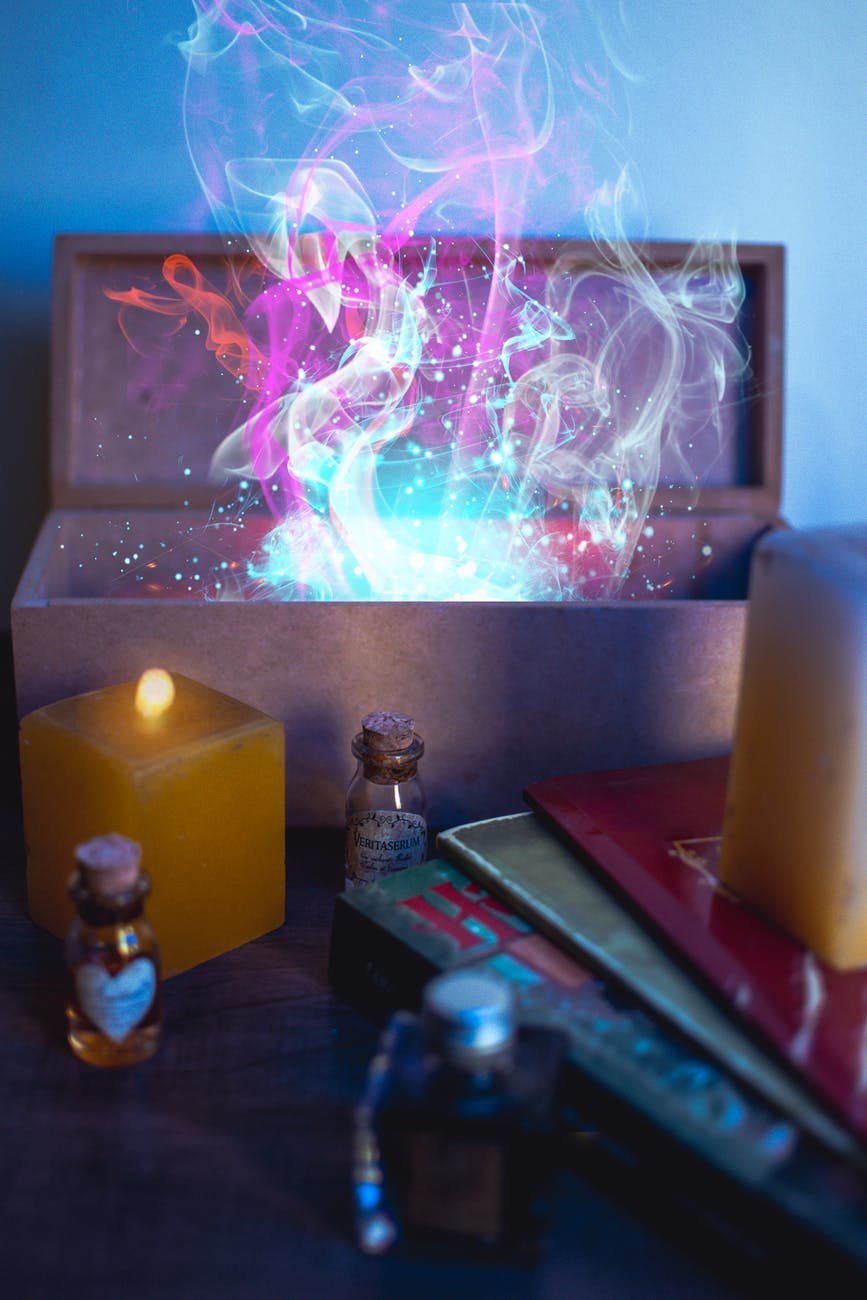
The final element of magic in Summer Sorcery is potion craft. Again this wasn’t thrown in at random. Potions gave me two neat features. Firstly, it provides a means of magic persisting before being used. Everything else in the stories is immediate. It happens when cast and lasts as long as it lasts. For some situations (like the opening chapters) I needed magic to persist in a dormant state until called on. Secondly, it gave me another system to play with. A much more rigorous system at that. Potions allowed me an excuse to delve into real-world folklore to see what properties people have (and still do, sometimes) ascribe to different things. I always love it when fantasy stories are grounded in real folklore. To me it lets them reach beyond the page and bleed into the world around me. I suspect I’m not alone in wanting a bit of extra magic about just now.
 Brandon Lim